
The signs your septic tank is full are slow drains throughout the house, gurgling pipes, wastewater backing up into toilets or sinks, sewage odors, and soggy or unusually bright green ground over the tank or drain field. These are the common signs the U.S. EPA lists for a septic system that is struggling. They can have other causes, so treat them as a reason to have a septic professional look at the tank, not as a diagnosis.
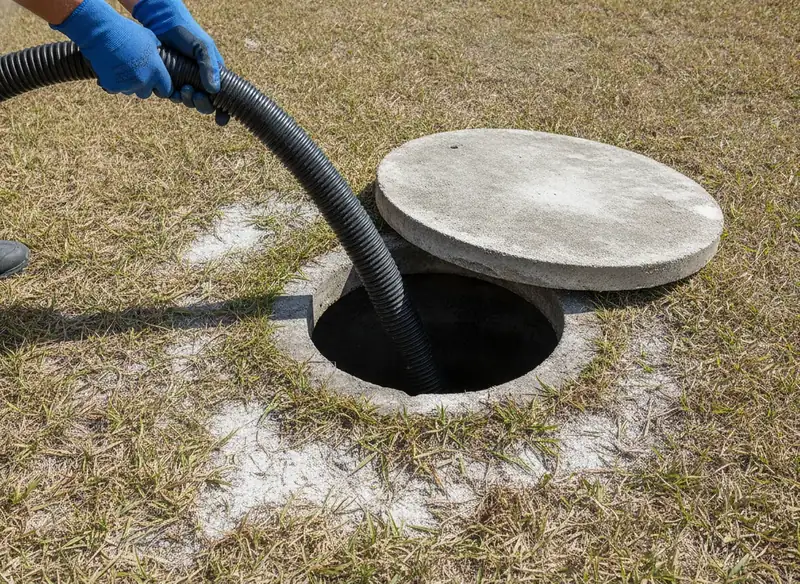
How a septic tank fills up
Every drain in the house ends up in the tank. Solids settle to the bottom as sludge, grease and light material float as scum, and the liquid in between flows out to the drain field. EPA explains that if a large amount of water enters the tank or it fills with solids, solids can be pushed into the drain field, where they clog the pipes. A full tank is therefore a problem you can often prevent with regular pumping, which UF/IFAS Extension puts at every three to five years; see our guide on how often to pump a septic tank in Florida.
7 signs your septic tank is full
1. Drains are slow in more than one place
EPA lists bathtubs, showers and sinks draining very slowly as a sign of a failing system. One slow sink is usually a local clog. When the shower, the kitchen sink and the washing machine all slow down together, the cause may be downstream, in the tank or the drain field.
2. Gurgling sounds in the plumbing
Gurgling when you flush or run the washer is on EPA's list.
3. Water or sewage backs up indoors
EPA names water and sewage backing up from toilets, drains and sinks. This is the clearest sign something is wrong. Use as little water as you can until the system is checked.
4. Standing water or damp spots over the tank or drain field
Standing water or damp spots near or over the tank or drain field are another EPA-listed sign. After a heavy summer storm some wetness is normal in low yards, so look at whether the spot stays wet days after the rain stops.
5. Sewage odors around the tank or drain field
EPA lists sewage odors around the tank or drain field. EPA also notes that a smell can come from a clogged roof vent or a change in wind pattern, so an odor alone does not prove the tank is full.
6. Bright green, spongy grass over the system
EPA lists bright green, spongy, lush grass over the tank or drain field, even during dry weather.
7. It has been longer than three to five years
The quietest sign is the calendar. EPA says household tanks are typically pumped every three to five years and an average system should be inspected at least every three years. If you cannot remember the last pump-out, or just bought the house, the tank may simply be due.
How a professional tells if a tank needs pumping
You cannot see the layers from the lid, so the measurement is made by a septic service company. EPA says a tank should be pumped if the bottom of the scum layer is within six inches of the bottom of the outlet, if the top of the sludge layer is within 12 inches of the outlet, or if more than 25 percent of the liquid depth is sludge and scum. When a Florida tank is pumped, Rule 62-6.010(4)(a) requires all chambers to be emptied, and a partial pump-out must be documented in writing.
What to do if you notice a sign
- Spread out laundry and cut water use until the tank is checked.
- Do not drive or park on the drain field.
- Skip chemical drain openers, which EPA says to avoid in favor of boiling water or a drain snake.
- Get a written quote, and ask the company for its DEP septic tank contractor registration number and the septage disposal service permit number on the truck.
Do not pump during flooding
Ocala's rainy season brings 27.91 of the year's 51.64 inches of rain from June through September (NOAA 1991–2020 normals). If the yard is under water, UF/IFAS Extension says not to have the tank pumped until the floodwaters recede, because an emptied tank in saturated ground can lift. Wait for the water to go down, then have the system checked.
Septic tank pumping in Dunnellon, Summerfield and the rest of Marion County
Septic is the norm outside city sewer. In the Florida Department of Health parcel data used in our research, ZIP code 34491, which covers Summerfield, has about 8,997 septic parcels, the most of any ZIP in Marion County, and Dunnellon's ZIP codes 34431 and 34432 have roughly 3,275 and 3,845 (approximate parcel counts, not households). For local notes see Summerfield and Dunnellon.
Get a free quote for septic tank pumping
Florida Septic Works connects Ocala and Marion County homeowners with independent local septic companies for free, no-obligation quotes. Florida Septic Works is a referral service, not a septic tank contractor; the work is done by independent DEP-registered septic tank contractors, who quote, contract and do the job. Read about septic tank pumping, see typical prices in the septic tank pumping cost guide, or request a free quote. We usually reply the same day. If the inspection finds damage that needs a DEP repair permit, expect the permit to call for a nitrogen-reducing system in most of Marion County; our ENR guide explains why.
Frequently asked questions
How do I know if my septic tank is full?
Slow drains in several fixtures, gurgling pipes, backups, sewage odors and soggy or unusually green ground over the tank or drain field are the common signs EPA lists for a struggling system. Only a septic professional can measure the scum and sludge layers, so ask a registered contractor to check the tank.
Can a septic tank be full right after it was pumped?
A freshly emptied tank is not full, so symptoms soon after a pump-out point to something else, such as a clogged line, a blocked vent, a failed baffle or a saturated drain field. Ask the company what it saw when it opened the tank, and request the written pump-out record Florida rules call for.
Should I pump my septic tank if the yard is flooded?
No. UF/IFAS Extension says not to have the tank pumped until floodwaters recede, because an emptied tank in saturated ground can lift. Cut water use while the drain field is flooded, then have the system checked by a septic professional once the water goes down.