
How often should you pump your septic tank in Florida? Every three to five years is the common guidance: UF/IFAS Extension tells Florida homeowners to “have your septic tank pumped every three to five years.” No Florida law or DEP rule sets a fixed pumping interval for a home system, so where you fall in that range depends on your tank size, how many people live in the house and how the system is used.
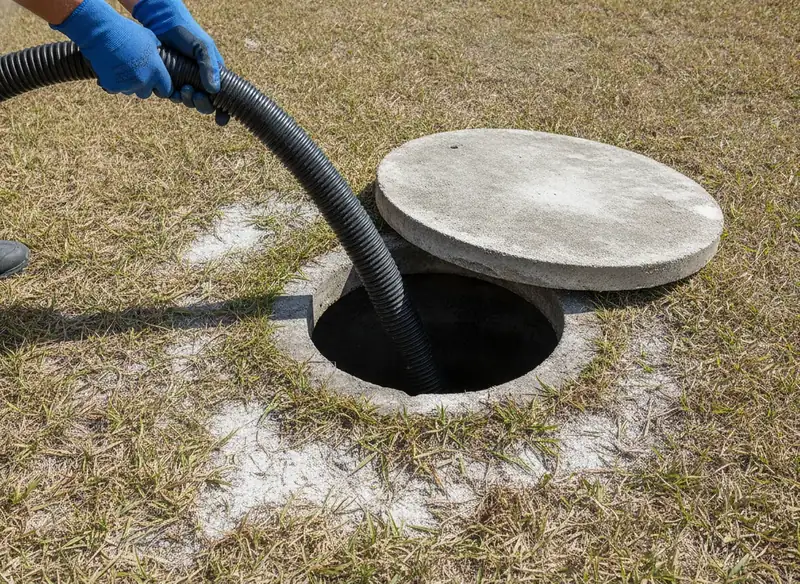
How often to pump by tank size: Florida's bedroom rule
A bigger tank holds more solids before it needs emptying. Florida Rule 62-6.008 sets minimum tank sizes from the home's estimated sewage flow, which is based on bedrooms and floor area (whichever gives the larger flow):
| Home | Estimated flow | Minimum tank |
|---|---|---|
| 1–3 bedrooms (up to 2,250 sq ft) | up to 300 gallons a day | 900 gallons |
| 4 bedrooms (2,251–3,300 sq ft) | 400 gallons a day | 1,050 gallons |
| 5 bedrooms | about 460 gallons a day | 1,200 gallons |
Florida tanks must also be multi-chambered (or placed in series) with an approved outlet filter. If you do not know your tank size, the system's permit records may show it; in Marion County you can ask DEP's program staff ([email protected], 850-245-8362) for records.
Household size and daily habits
The rule sizes a tank by bedrooms because more bedrooms usually mean more people and more wastewater. A 900-gallon tank serving a full three-bedroom house fills with solids faster than the same tank serving one or two people, so a busy house tends to sit at the short end of the three-to-five-year range. A garbage disposal sends food solids into the tank, and guests or a home business add flow too. There is no published Florida figure for how much any of these shortens the interval, so tell the pumping company how the house is used and ask what it sees in your tank when it pumps.
Aerobic treatment units: inspections twice a year
Some Marion County homes have an aerobic treatment unit (ATU), one of the nitrogen-reducing system types the Silver Springs and Rainbow Springs BMAP now calls for on new systems. ATUs work on a different schedule. Under s. 381.0065(4)(v), the owner must keep a maintenance service agreement with a DEP-permitted maintenance entity, which must inspect the system “at least twice each year.” The owner also needs a DEP operating permit ($100 every two years). The maintenance provider can tell you when the unit's tanks need pumping. Our ENR septic requirements guide explains the rules.
Timing: pumping around Ocala's rainy season
NOAA's 1991–2020 normals for the Ocala station show 51.64 inches of rain a year, and 27.91 inches of it (54%) falls from June through September. November (2.09 inches) and April (2.22 inches) are the driest months. A routine pump-out is easier to plan in a drier month, when the yard is firm and the lid is easy to reach, than in the middle of the summer storm season.
Do not pump during flooding
UF/IFAS Extension's hurricane guidance (SS739) is clear: reduce water use before a storm, switch off the septic pump at the breaker before flooding, stop using toilets and faucets while the drain field is flooded, and “do not attempt to have the septic tank pumped until the floodwaters recede.” An empty tank in saturated ground can float. Once the water goes down, have the system inspected.
What a proper Florida pump-out includes
Rule 62-6.010(4)(a) says the contents of a tank, “including all chambers of a multi-chambered tank,” must be removed in their entirety when pumped. If the pumper leaves material behind, it must explain why in writing, with the gallons pumped. Septage must go to a DEP-approved facility; spreading it on land has been banned since January 1, 2016. Before you book, ask for the company's DEP septic tank contractor registration number, look for the septage disposal service permit number lettered on the truck, and get a written quote. In 2026, pumping a 1,000-gallon tank in Marion County typically runs about $300–$450 (an estimate from Fixr and homeyou Ocala figures, not a quote); see the septic tank pumping cost guide.
Get quotes for septic tank pumping in Ocala and Marion County
Florida Septic Works connects Ocala and Marion County homeowners with independent local septic companies for free, no-obligation quotes. Florida Septic Works is a referral service, not a septic tank contractor; the work is done by independent DEP-registered septic tank contractors. Read about septic tank pumping, see local notes for Ocala and Belleview, or request a free quote. We usually reply the same day.
Frequently asked questions
Does Florida law require septic pumping on a schedule?
No. No Florida rule sets a pumping interval for a standard home septic tank. UF/IFAS Extension advises Florida homeowners to have the tank pumped every three to five years. When a tank is pumped, Rule 62-6.010(4)(a) requires all chambers to be emptied, and a partial pump-out must be explained to the owner in writing.
Should I pump my septic tank after a hurricane or flood?
Not while the ground is flooded. UF/IFAS Extension says: “Do not attempt to have the septic tank pumped until the floodwaters recede,” because pumping a tank in saturated ground can lift it. Cut water use while the drain field is flooded, and have the system checked by a septic professional as soon as possible after the water goes down.
Does pumping my tank trigger an ENR upgrade in Marion County?
A routine pump-out is not a repair, modification or replacement, so on its own it is not the Silver Springs and Rainbow Springs BMAP trigger. The upgrade rule applies when a system needs a DEP construction permit to repair, modify or replace it. If the pumping company finds damage that needs a repair permit, expect the permit to call for an ENR system.