
Septic Tank Abandonment in Florida: The 90-Day Rule, Permits and Steps
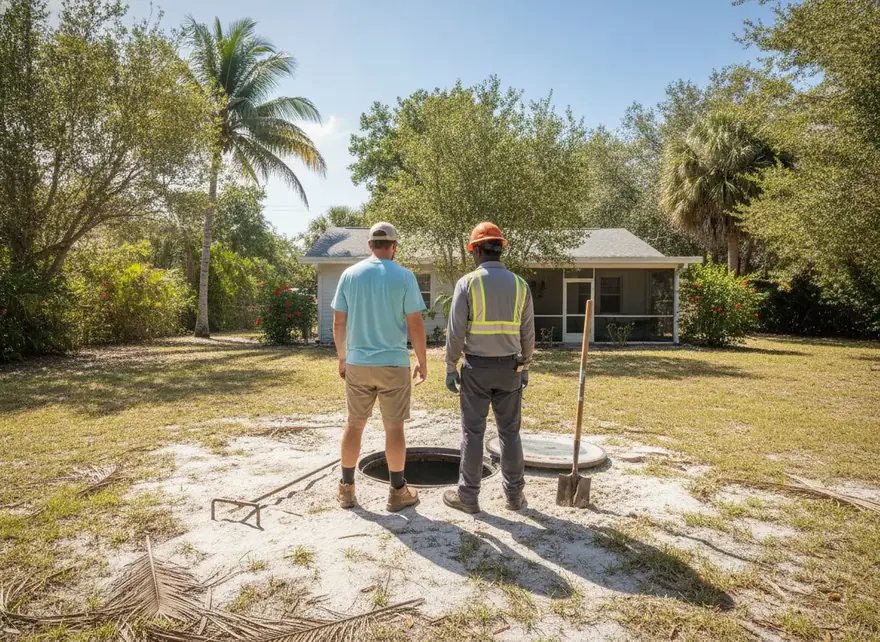
Septic tank abandonment in Florida is governed by Rule 62-6.011 of the Florida Administrative Code. When a home connects to sewer, or an old tank is replaced with a new one, the rule says the old system “must be abandoned within 90 days and any further use of the system or tank(s) for any purpose is prohibited.” Abandoning a tank means a permit, a pump-out, breaking or collapsing the tank, and filling it with clean sand. The rule was last amended on June 8, 2026, and the process changed, so older checklists may be out of date.
When does a septic tank have to be abandoned?
Rule 62-6.011(1) names two triggers:
- The property connects to sewer. Once the building is on a central sewer system, the septic system is out of use and the 90-day clock applies.
- The tank is replaced. If a tank is taken out of use and another onsite sewage tank takes its place, the old one has to be abandoned.
The sewer trigger matters in Marion County. Under s. 381.00655, Florida Statutes, an owner must connect within 365 days of written notice that sewer is available. Marion’s septic-to-sewer program covers unincorporated Program Areas, with Silver Springs Shores as the first project. The septic-to-sewer guide covers the connection rules; this post picks up at the old tank.
Florida septic tank abandonment permits: two routes
The rule says abandonment “must be conducted pursuant to a general permit or a system construction permit, unless excepted in this rule.” Here is how the two compare.
| Question | General permit | System construction permit |
|---|---|---|
| Who starts it | The contractor doing the abandonment files a notice of intent as agent for the owner | The property owner or an agent applies on DEP Form 4015 |
| What DEP issues | Form DEP 4011, General Permit for System Abandonment, valid for 18 months | A system construction permit for the abandonment |
| How it is verified | Pump-out receipt, photographs and the contractor’s certification | An inspection by DEP or a private provider inspector, with a photo report |
Under the general permit, the rule says DEP will not make an onsite inspection unless the paperwork “is incomplete or otherwise indicates potential noncompliance.”
The notice of intent lists the owner, the contractor’s license details, the address and parcel number and a description of the system. In Marion County these filings go through DEP’s online portal at osp.floridadep.gov. DEP’s Marion staff can be reached at OSP_CSA@FloridaDEP.gov or 850-245-8362.
Call (877) 752-8911The abandonment steps, in the order the rule lists them
- Permit first. The notice of intent and fee go to DEP, and DEP issues the general permit.
- Pump the tank. The tank “must be pumped out by a permitted septage disposal company,” which gives a receipt or written certification. If the tank is already empty and dry, a written statement saying so goes to DEP instead. This is ordinary septic tank pumping.
- Open, rupture or collapse it. The bottom of the tank has to be opened or ruptured, or the whole tank collapsed, “to prevent the tank from retaining water.”
- Fill and cover. The tank is filled with “clean sand or other suitable material, and completely covered with soil.” If it cannot be ruptured or collapsed, “the fill material must be flowable fill concrete.”
- Or remove it. As an alternative to steps 3 and 4, the tank may be taken off the site under the rule’s spoil-material procedures.
- Certify and document. The contractor signs the completion certificate on Form DEP 4011 and sends DEP the pump-out receipt and the photographs.
The photos DEP now asks for
For general-permit jobs, photographs take the place of a routine inspection. They must be in a common digital format “with metadata attached, including the date, time, and location of the tank and property,” and must show:
- The empty tank with the bottom ruptured, the tank collapsed, or the tank removed.
- Clean sand or other suitable material placed inside the ruptured or collapsed tank.
- The tank location completely filled.
- At least one view that includes the house or a clearly identifiable landmark, to confirm the location.
Ask the contractor for copies of the photos, the pump-out receipt and DEP’s acknowledgment of completion. No public address search for Marion septic records was found, so keep your own file. See the septic records guide.
Replacing a tank: no separate abandonment permit
Rule 62-6.011(3)(b) covers tank replacements. When the new tank goes in under its own system construction permit, that application has to specify the tank or tanks being abandoned as part of the job, and the separate abandonment permit steps are not required.
In Marion County the bigger issue is the permit itself. Under the Silver Springs and Rainbow Springs BMAP, an existing system must be upgraded to a nitrogen-reducing (ENR) system whenever a DEP repair, modification or replacement permit is needed, unless sewer is planned and funded. Most of Marion County is inside the BMAP; confirm your parcel on DEP’s BMAP map before agreeing to a tank swap. The septic system installation page and the septic system installation cost page explain what that upgrade involves.
Call (877) 752-8911Can an old septic tank become a cistern?
Yes, for a single-family home, at the owner’s choice, under Rule 62-6.011(4). It needs a system abandonment construction permit that states the intended use. The tank must be disconnected from the drainfield and the building sewer, then emptied, cleaned, disinfected and filled with water. DEP inspects it and samples the water for pH, chlorine, coliform bacteria and clarity. The conversion and inspection have to happen within 90 days of the sewer connection, and afterward the water may be used “for non-potable, irrigation purposes only.”
Who can do the work, and what it costs
Florida law, s. 381.0065(4), says a person may not contract to “abandon” any part of a septic system without being registered. The general permit is built around a contractor: the completion certificate on Form DEP 4011 is signed by a registered septic tank contractor, a master septic tank contractor or a licensed plumber. The sewer hookup itself is plumbing-contractor work. If you want to do any of it yourself on your own owner-occupied home, ask DEP’s Marion staff what the rule allows first.
On cost, the state fee schedule in Rule 62-6.030 lists $50 for abandonment; confirm the total with DEP, because surcharges can apply. We found no reliable published price for the contractor’s part of an abandonment, so ask for a written quote that separates the pump-out, the rupture and fill, and the permit fee. For scale, a routine pump-out of a 900 to 1,000 gallon tank typically runs about $225 to $400 (Fixr, January 2025; an estimate, not a quote). If the old tank is failing and sewer is not available, look at septic tank repair first.
Get quotes for a septic tank abandonment in Marion County
Florida Septic Works is a referral service, not a septic tank contractor. We connect Ocala and Marion County homeowners with independent local septic companies, who quote, contract and do the work. Ask any company for its DEP septic tank contractor registration number, proof of insurance and a written quote. Request a free, no-obligation quote and mention that the job is a tank abandonment. We usually reply the same day.
FAQ
How long do I have to abandon a septic tank after connecting to sewer in Florida?
Ninety days. Rule 62-6.011(1) says that when a septic system is discontinued after a sewer connection, or a tank is replaced with another tank, the system must be abandoned within 90 days, and any further use of it for any purpose is prohibited. The only exception is a tank DEP approves as part of a permitted sewer or stormwater system.
Do I need a permit to abandon a septic tank in Marion County?
Yes, in most cases. Rule 62-6.011 requires either a general permit, started by the contractor’s notice of intent, or a system construction permit. In Marion County both go to Florida DEP, which has issued septic permits there since July 1, 2025. No separate abandonment permit is needed when the tank is replaced under its own construction permit or a local utility runs its own abandonment program.
Can I just fill an old septic tank with dirt?
Not by itself. The rule lists the steps in order: a permit, a pump-out by a permitted septage disposal company, opening or rupturing the bottom or collapsing the tank so it cannot hold water, then filling with clean sand or other suitable material and covering with soil. A tank that cannot be ruptured or collapsed must be filled with flowable fill concrete.
This is general information, not legal advice. Rules change; check the current text of Rule 62-6.011 or ask DEP before you rely on it.