
Septic tank records in Florida are the paper trail for the system under the yard: the permit, a site plan showing where the tank and drain field went, and the inspection that approved it. Homeowners want them before a repair, buyers and realtors want them before closing, and county staff field the calls. The trouble is that no single search box covers the state, and in Marion County the agency changed in 2025. This guide lists the routes that exist, says plainly which ones are untested, and explains what the records show.
An honest note before you start. As of October 19, 2026, no public address search for Marion County septic records could be found. The routes below are the ones official sources point to, but none of them has been tested for every Marion address, and none is promised to turn up a file. Some properties, especially older ones, have little or no record. This is general information, not legal advice.
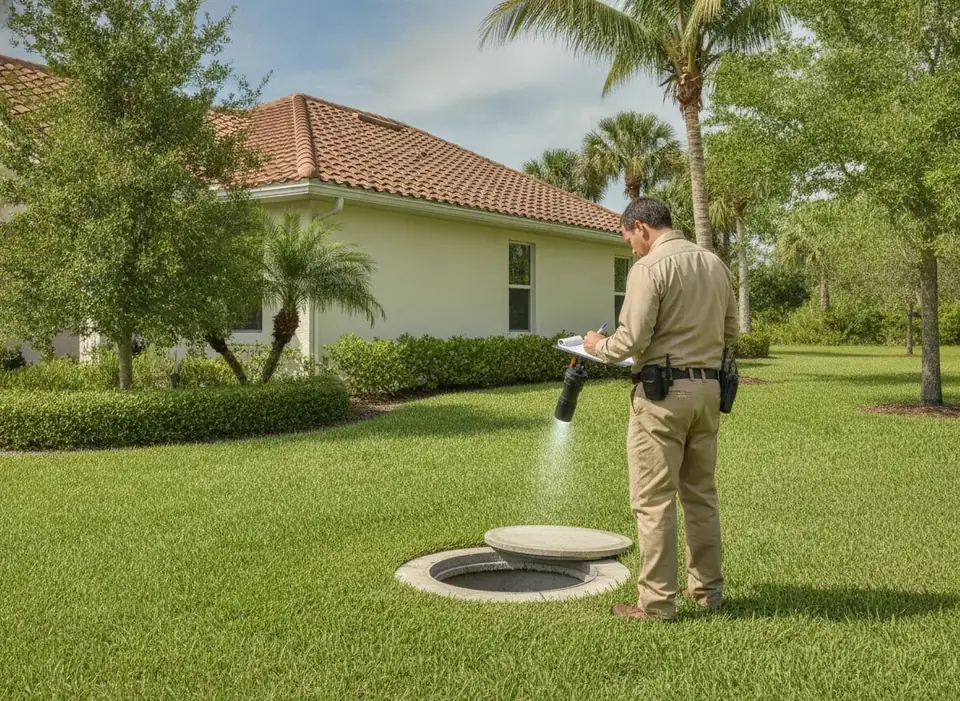
Septic tank records in Florida: who holds them
Where to look depends on which agency permits your county. Florida's Department of Environmental Protection (DEP) took over the septic program in 2021 and has been taking over local permitting in phases: 16 Panhandle counties from January 2, 2025 and Marion County from July 1, 2025. Everywhere else, the county health department still permits, and it usually still holds the files. (Our Florida septic permits guide explains the change.)
| County | Who permits now | Where records may be | Start here |
|---|---|---|---|
| Marion | DEP (since July 1, 2025) | DEP for recent permits; older files may still be with the Florida Department of Health in Marion County | [email protected] or 850-245-8362; Oculus search guide |
| Bay, Calhoun, Escambia, Franklin, Gadsden, Gulf, Holmes, Jackson, Jefferson, Leon, Liberty, Okaloosa, Santa Rosa, Wakulla, Walton, Washington | DEP (Phase I from January 2, 2025) | DEP; older files possibly with the county health department | DEP staff directory |
| Alachua, Lake, Sumter, Levy, Putnam, Citrus | County health department | The county health department's environmental health office | DOH county locations |
| Lafayette, Suwannee | County health department | Searchable through SepticSearch.com, a tool those offices use | Not usable for Marion |
| St. Lucie | County health department | St. Lucie offers a public records search | Not usable for Marion |
| Other counties | County health department | Ask the county health department | DOH county locations |
Before you contact anyone, gather the property address, the parcel ID from the property appraiser's record, the owner's name, and if you know it, roughly when the house was built or the system was last replaced. Those details make any request easier to match.
Route 1: Ask DEP's Marion County staff
For a Marion County property, the most direct route is to ask the people who now run the program. DEP's Onsite Sewage staff directory says to "email Marion County program staff at [email protected] or call our main phone line at 850-245-8362." Ask whether they hold a permit file for your address, how to get a copy, and whether older files are still with the Department of Health in Marion County. DEP's online portal, osp.floridadep.gov, is for applications and service requests, not record lookups.
Questions about getting quotes? Call (727) 300-6656
Route 2: Search DEP's Oculus document system
Oculus is DEP's public document library. DEP's public Oculus search guide describes searching "by facility, site names or street addresses" through the Information Portal. It was not confirmed that Marion septic permit files are filed in Oculus, so treat this as a route worth a few minutes, not a sure thing. If a search finds nothing, that does not mean no permit exists; the file may be on paper or with the health department.
Route 3: File a DEP public-records request
If staff email doesn't get you a file, you can make a formal public-records request to DEP. DEP's Oculus tips list [email protected] for regulatory records. Give the address, parcel ID and owner name, say you are looking for onsite sewage (septic) permit, site plan and inspection records, and ask whether any older files transferred from the Department of Health. A request may take time, and the answer may be that no record exists.
Questions about getting quotes? Call (727) 300-6656
Route 4: DOH statewide datasets and the state septic inventory
DEP's Inspection Reports and Data page links to statewide datasets kept by the Department of Health: OSTDS construction approvals, final approvals, permits issued, contractor enforcements and the contractor list. These are large data files rather than a records counter, so they suit realtors, researchers and county staff more than a homeowner after one file.
There is also the state's septic inventory, the Florida Water Management Inventory, published as a DEP map service. It marks each parcel as "known," "likely" or "somewhat likely" septic. In its 2020 data it counts 99,901 septic parcels in Marion County, and DEP notes that "permit information related to septic systems generally ranges from the late 1990s onward." It can help confirm that a parcel is on septic, but it is not the permit file itself.
Route 5: County tools and other paper trails
Outside Marion and the Panhandle, start with the county health department. A few counties have their own search tools, such as SepticSearch.com for Lafayette and Suwannee and St. Lucie's public records search. Don't expect those to cover Marion addresses.
Other places a record may turn up:
- The seller or previous owner. Closing packets, repair invoices and permit copies often stay in a kitchen drawer.
- The county records office. Cost guide Fixr suggests asking for an "as-built" drawing there.
- Past pumping companies. Florida Rule 62-6.010(7)(b) requires haulers to log the date, address, gallons pumped and disposal facility for each job and keep the log for 5 years. A company isn't required to share it, but many will tell a homeowner when they last pumped the tank. See septic tank pumping.
Questions about getting quotes? Call (727) 300-6656
What septic records show, and what they don't
A complete permit file can include:
- The permit application and the site plan, which shows where the tank and drain field were placed relative to the house and lot lines.
- The site evaluation: soil conditions and the seasonal high water table at the time.
- The approved system: tank size, drain field size and system type (conventional, aerobic or nitrogen-reducing).
- Inspection and final approval records, and any later repair or modification permits.
- For aerobic treatment units, the operating permit, which runs on a two-year cycle with a $100 state fee.
A record does not tell you the system's condition today. A tank approved in 2005 may be working fine or may need a new drain field. Only an inspection by a DEP-registered septic tank contractor can tell you that.
Why buyers and realtors want the records
Florida does not require a septic inspection when a house sells. Section 381.0065(4)(x) says one "may not be mandated by a governmental entity at the point of sale," and permits "transfer with the title to the property." That puts the homework on the buyer. Florida Realtors (September 29, 2026) advises buyers' agents to "encourage the buyer to obtain appropriate septic inspections and evaluate sewer availability," and Florida sellers must disclose known defects that materially affect value (Johnson v. Davis, 1985).
Records help in three ways:
- Size versus bedrooms. Rule 62-6.008 sets a minimum of 900 gallons for 1 to 3 bedrooms (up to 2,250 sq ft), 1,050 gallons for 4 and 1,200 for 5. A 4-bedroom house on a permit for 3 bedrooms is worth a question.
- System type and upkeep. An aerobic unit needs a maintenance agreement with inspections at least twice a year and a DEP operating permit.
- The Marion ENR trigger. In Marion's Silver Springs and Rainbow Springs basin plan, an existing system that needs a repair, modification or replacement permit must be upgraded to a nitrogen-reducing (ENR) system unless sewer is planned and funded. Florida Realtors puts ENR at about $15,000 to $35,000 or more. Most of Marion County is inside the plan area; confirm a parcel on DEP's BMAP map and read our ENR requirements guide.
If sewer is coming to the street, the septic-to-sewer guide covers the connection deadlines.
If you can't find a record
A missing file is common and is not, by itself, a sign of trouble. The practical next step is a septic inspection: a DEP-registered contractor can locate the tank, check its condition and pump it if needed. See septic inspection and typical prices in the septic inspection cost guide. Before any work, ask for the contractor's DEP septic tank contractor registration number (check it from DEP's registration page), proof of insurance and a written quote.
Septic records FAQ
Can I look up my septic permit by address in Marion County?
No public address search for Marion County septic records was found as of October 19, 2026. DEP took over Marion permitting on July 1, 2025, and its online portal is for applications. The main routes are emailing DEP's Marion staff at [email protected], searching DEP's Oculus document system, or filing a DEP public-records request. None of these is promised to produce a file.
What does a septic permit record show?
A permit file can include the application, a site plan showing where the tank and drain field were placed, the site evaluation of the soil and water table, the approved system design and tank size, and inspection or final approval records. Older or repaired systems may have partial files, and some properties have no file at all.
Why do home buyers ask for septic records?
Records help a buyer see the system's age, size and location, past repairs, and whether it is an aerobic unit that needs a maintenance contract. In Marion County, a failed system that needs a repair permit must be upgraded to a nitrogen-reducing system, which Florida Realtors puts at about $15,000 to $35,000 or more, so the history matters.
What if no septic records exist for my house?
Ask the seller and any past pumping company for paperwork, and check with the agency that permits your county. If nothing turns up, a septic inspection by a DEP-registered septic tank contractor can locate the tank and report its condition. Ask for the contractor's registration number and a written quote before the work starts.
More guides: all Florida Septic Works guides. Want prices on an inspection or pump-out? Request free quotes from independent local septic companies.